
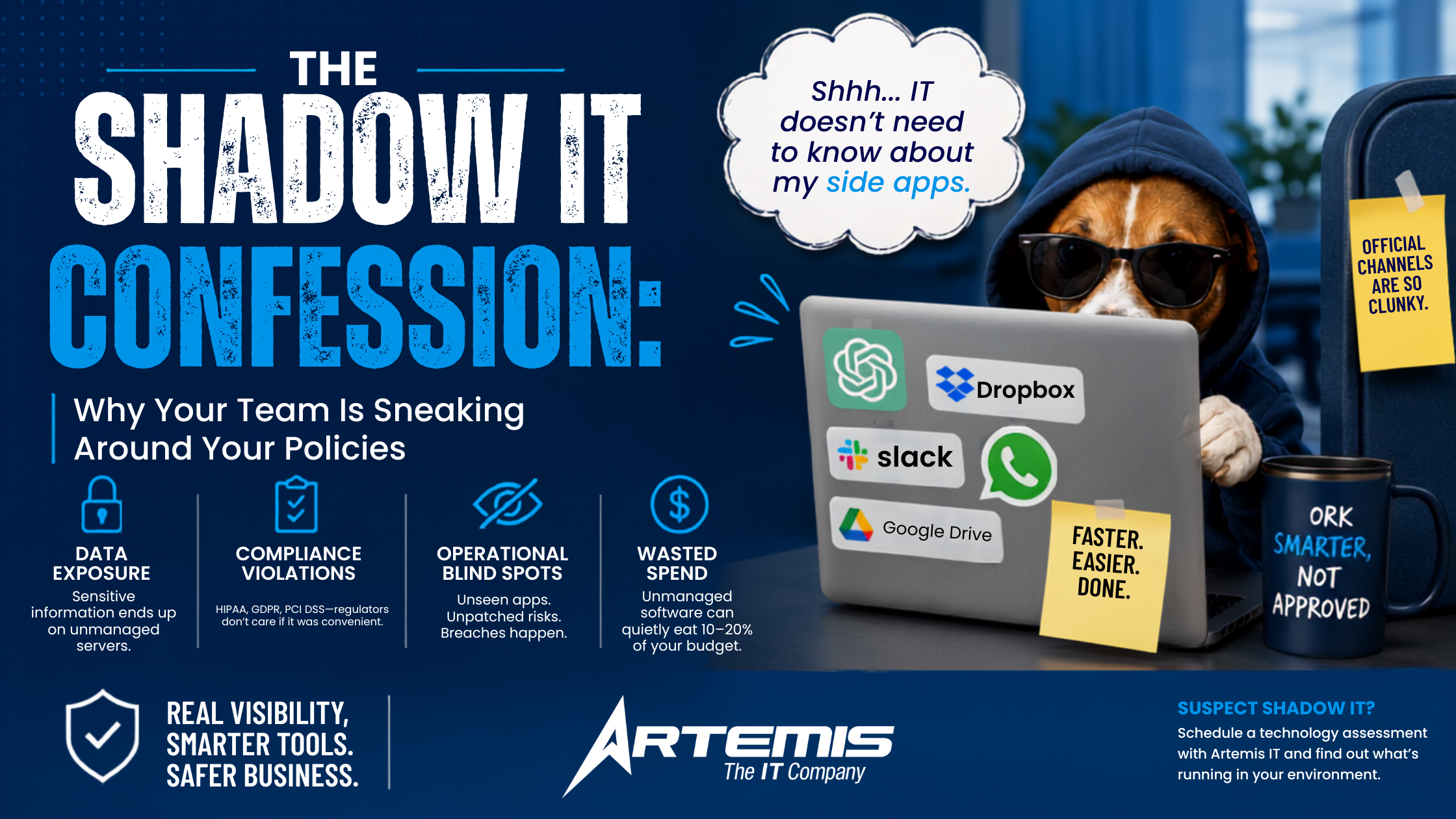
The Shadow IT Confession: Why Your Team Is Sneaking Around Your Policies
Your employees are using apps right now that your IT department has never approved, never reviewed, and probably does not even know exist. There is a good chance one of them just pasted a client proposal into a free AI chatbot, shared an oversized file through a personal Dropbox, or set up a Slack alternative on their phone because the official channel felt clunky.
This is not a rumor. It is daily business reality, and the instinct to crack down on it is understandable but largely misdirected.
What Shadow IT Actually Is
Shadow IT happens when employees use hardware, software, or cloud services without the knowledge or approval of the IT department. It usually has nothing to do with malicious intent. Employees turn to these tools because they are simply trying to find a faster, easier way to get their work done.
The scale of this is larger than most leadership teams realize. Microsoft’s own research found that 80 percent of employees use non sanctioned apps that have never been reviewed and may not meet security or compliance standards, and when IT leaders are asked how many cloud apps their teams actually use, they tend to guess 30 or 40, when the real number often exceeds a thousand. This is not a rebellious minority. It is standard behavior across the modern workplace, happening in your business right now whether you have noticed it or not.
It is also worth saying plainly that shadow IT is not purely a liability. Employees often adopt new tools because those tools genuinely help them move faster and solve problems IT has not gotten to yet. That instinct toward speed and resourcefulness is valuable. The issue is not that employees want better tools. The issue is when that resourcefulness happens completely outside any visibility or safeguard. That turns a legitimate productivity win into an unmanaged risk.
Common Examples Showing Up in Businesses Every Day
A few scenarios probably sound familiar.
Someone on your team pastes sensitive client information into a personal ChatGPT account to speed up a proposal. A project manager uses a personal Google Drive to send large files because the company network feels too slow. A small group sets up an unauthorized WhatsApp thread for quick coordination instead of using Microsoft Teams. Someone brings in a personal laptop, or worse, an unencrypted USB drive, to work on company files from home.
None of this comes from bad intentions. It comes from friction.
Why Shadow IT Risk Keeps Growing
Three forces are driving this trend, and none of them are going away.
First, official procurement and approval processes are often too slow for how fast business actually moves. By the time IT signs off on a new tool, the team has already found a workaround.
Second, consumer apps are simply more pleasant to use than a lot of enterprise software. People are used to slick, intuitive interfaces in their personal lives, and they expect the same at work.
Third, remote and hybrid work have blurred the line between personal and professional devices so thoroughly that slipping into an unapproved workflow barely registers as a decision anymore.
The result is not a small problem confined to a few departments. In 2026, shadow IT has matured into a business risk that spans every department, not just IT. Employees continue prioritizing speed and flexibility over formal approval.
It Is Not Just Employees. Departments Do This Too.
Most conversations about shadow IT risk focus on individual employees pasting data into a chatbot or sharing files through a personal account. That is real and growing, but it is not the whole picture, and for executives it may not even be the most expensive part.
Entire departments adopt unapproved technology on their own, often with real budget and intention behind it. A marketing team signs up for a new analytics platform. A sales team brings in its own proposal software. IBM points out that shadow IT is not always the result of individual employees acting alone. Whole teams adopt these tools too. Gartner found that 38 percent of technology purchases are now managed, defined, and controlled by business leaders rather than IT. That means a meaningful share of your company’s technology decisions are happening completely outside the systems built to secure and support them.
This version of shadow IT risk often carries a bigger price tag than a single employee’s personal Dropbox account. Department level purchases tend to involve real budget, real data, and real integration with other business systems. It deserves just as much attention as individual workarounds, if not more.
That said, department led technology adoption is not automatically a bad thing. When it happens with visibility and governance in place, it can genuinely speed up innovation. Teams get the tools they actually need instead of the ones a slow approval queue eventually hands them. The goal is not to shut this down. It is to make sure IT knows it is happening and can support it safely, rather than discovering it after a breach or an audit forces the issue.
The Real Risks Hiding Inside Convenient Workarounds
Shadow IT risk is not just a technicality for the IT department to worry about. It has direct consequences for the business as a whole.
Data exposure. When sensitive client information or intellectual property ends up on unmanaged third party servers, your business loses control over where that data goes and who can access it.
Compliance violations. Industries governed by HIPAA, GDPR, or PCI DSS face serious exposure when employees use unapproved tools. Regulators do not care that the tool was convenient. They care whether you protected the data the way you should have. The U.S. Department of Health and Human Services HIPAA guidance outlines exactly how strict this standard is for any business handling protected health information.
Operational blind spots. IT teams cannot patch, secure, or back up something they do not know exists. Unmanaged assets are involved in more than a third of all data breaches. Every unapproved tool your team or your departments adopt quietly increases your overall exposure, often without anyone realizing it until something goes wrong.
Wasted spend. Beyond security, there is a financial cost too. Unmanaged software can quietly consume between 10 and 20 percent of a company’s overall software budget, often through duplicate subscriptions that finance never sees coming.
Don’t Blame Employees. Start Fixing the System.
Here is the shift that matters most for executives and operations leaders: shadow IT risk is rarely a people problem. It is a symptom of IT infrastructure that has not kept pace with how your team, and your departments, actually want to work.
Blocking tools and issuing stern policy memos does not solve this. It often makes things worse, since the behavior simply moves further out of sight. Block one tool and people find three more, often hidden from view on purpose, which creates a worse problem than the one you started with. The UK’s National Cyber Security Centre echoes this directly. It advises organizations to take a no blame approach with employees who turn to shadow IT. Punishing staff only makes their coworkers less likely to disclose their own workarounds, which leaves you with even less visibility than before.
Turning Restriction Into Enablement
This is where the conversation should shift from controlling users to enabling them safely. CEOs and operations leaders do not want to be technology gatekeepers. They want their teams to be productive without putting the business at risk, and those two goals are not in conflict when the right systems are in place.
It is worth being precise about what enablement actually requires, because faster approvals alone are not the full answer. Cloudflare, a major web infrastructure and security provider, points out that shadow IT carries serious risk regardless of intent. Managing it effectively requires active discovery and monitoring tools alongside clear policy, not simply a better user experience on its own. In other words, giving employees and departments great sanctioned tools matters, but it only works as a long-term fix when it is paired with ongoing visibility into what is actually running across your environment. Speed without oversight just creates a faster path to the same blind spots.
A managed IT partner plays a central role here. Continuous monitoring identifies unauthorized tools already in use across your environment, whether one employee brought them in or an entire department adopted them. A fast, well communicated approval process for new software requests keeps people from feeling like they have to work around IT just to get their jobs done. And ongoing oversight makes sure every tool, sanctioned or otherwise, meets the security and compliance standards your business depends on.
At Artemis IT, our managed services approach is built around exactly this kind of proactive oversight, because the goal has never been to slow your team down. It has been to give them tools they can trust, supported by a system that sees the whole picture.
The Bottom Line
Your employees are not trying to undermine your IT policy. They, and the departments they work in, are trying to do their jobs well, and shadow IT risk shows up whenever official systems make that harder than it needs to be.
The fix is not more restriction. It is a smarter, faster, more responsive IT environment, paired with real visibility, that gives people what they need before they go looking for it elsewhere.
If you suspect shadow IT is already running quietly through your business, reach out to Artemis IT for a technology assessment to find out exactly what is operating in your environment, sanctioned or not.