
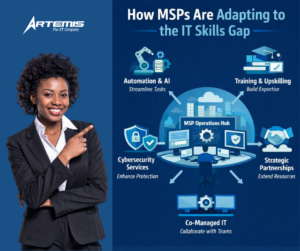
How Organizations of All Sizes Are Rethinking IT Support
The technology workforce is under pressure. Rapid innovation, evolving security threats, and increasingly complex IT environments have created a growing skills gap across the industry. At the same time, organizations of all sizes are facing persistent talent shortages that make hiring and retaining qualified IT professionals more challenging than ever.
From growing companies to large enterprises, these workforce challenges affect productivity, security, and long-term strategy. Managed service providers, or MSPs, are adapting their service models to help organizations navigate these realities. Understanding how MSPs address the skills gap and talent shortages can help business leaders make informed decisions about their IT approach.
Understanding the IT Skills Gap
The IT skills gap refers to the growing mismatch between the technical skills organizations need and the skills available in the workforce. As cloud platforms, cybersecurity frameworks, automation tools, and compliance requirements evolve, the demand for specialized expertise continues to increase.
Many organizations face challenges such as:
-
Limited access to advanced cybersecurity skills
-
Difficulty staffing cloud and infrastructure roles
-
Slower adoption of emerging technologies
-
Increased operational risk due to outdated systems
For larger organizations, the skills gap often results in siloed teams and over reliance on a small number of experts. For growing organizations, it can stall digital transformation entirely.
Talent Shortages Are Reshaping IT Teams
Even when budgets allow for hiring, talent shortages remain a major obstacle. Experienced IT professionals are in high demand, and competition for skilled workers continues to intensify. This impacts organizations in several ways:
-
Longer hiring cycles for critical IT roles
-
Increased workloads for existing teams
-
Burnout among internal IT staff
-
Reduced time for strategic planning
As organizations scale, these challenges compound. Maintaining internal expertise across every required technology discipline becomes increasingly difficult.
How MSPs Are Adapting to Workforce Challenges
Managed service providers have evolved their operating models to address both the skills gap and talent shortages. Rather than replacing internal IT teams, MSPs increasingly function as strategic partners that extend internal capabilities.
Building Multidisciplinary IT Teams
MSPs invest in teams that include specialists across infrastructure, cloud, cybersecurity, compliance, and application support. This allows organizations to access a broad range of expertise without hiring for each role internally.
Ongoing Training and Certification
To keep pace with technology change, MSPs prioritize continuous education. Technicians regularly complete vendor certifications and security training, ensuring clients benefit from current best practices and emerging solutions.
Supporting Hybrid IT Environments
Many larger organizations operate hybrid environments that combine on premises systems, cloud platforms, and legacy technology. MSPs adapt by offering flexible support models that integrate seamlessly with existing internal IT teams.
Leveraging Automation to Offset Talent Shortages
Automation plays a critical role in how MSPs adapt to limited talent availability. By automating routine tasks such as monitoring, patching, and alerting, MSPs reduce manual workloads and improve consistency.
Automation enables:
-
Faster issue detection and response
-
Reduced operational overhead
-
Improved system reliability
-
Better allocation of skilled resources
This approach allows MSPs to deliver high quality service at scale while preserving human expertise for complex and strategic initiatives.
Strategic Benefits for Organizations
Partnering with an MSP offers value beyond day to day support. For organizations navigating workforce constraints, MSPs provide measurable strategic advantages.
Scalable IT Support
MSPs scale services based on organizational needs, supporting growth, acquisitions, or changing business priorities without major staffing changes.
Improved Security and Compliance
With dedicated security expertise and continuous monitoring, MSPs help organizations reduce risk and meet regulatory requirements more effectively.
Cost Control and Predictability
Managed services provide predictable pricing models that help organizations plan budgets while avoiding the volatility of hiring, turnover, and emergency support costs.
Focus on Innovation
By offloading operational IT responsibilities, internal teams can focus on innovation, optimization, and business driven technology initiatives.
When an MSP Makes Sense
Organizations often consider an MSP when:
-
Hiring timelines cannot keep pace with business needs
-
Internal teams lack specialized expertise
-
Security risks are increasing
-
IT operations consume too much leadership attention
-
Technology strategy needs external perspective
In these situations, an MSP can act as a force multiplier, enhancing internal capabilities rather than replacing them.
Bottom Line: How MSP’s Are Adapting to the Skills Gap and Talent Shortages
The IT skills gap and ongoing talent shortages are not short term challenges. They are reshaping how organizations approach technology management across industries. MSPs continue to adapt by investing in people, automation, and flexible service models that meet the needs of both growing and large organizations.
By partnering with the right MSP, organizations can maintain secure, resilient, and scalable IT environments while navigating an increasingly competitive talent landscape.