
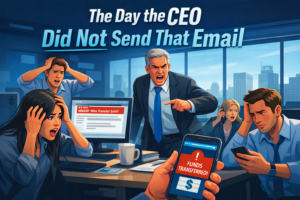
It started as a normal afternoon in the office. The finance team was moving through invoices, handling requests, and keeping everything on schedule. There were no red flags, no system alerts, and nothing to suggest that anything was wrong.
Then an email came in from the CEO.
The message was short and direct, asking for a wire transfer to be processed that day. It felt routine. The tone matched past emails, and the timing made sense given a busy executive schedule.
From the employee’s perspective, there was no reason to question it.
So they approved the request.
What Made This CEO Email Scam So Convincing
The problem was simple. The CEO never sent the email.
This is a classic CEO email scam, a form of business email compromise that targets employees who have access to financial systems or sensitive data. These attacks are not random. They are carefully designed to look legitimate and blend in with everyday communication.
Unlike traditional cyber threats, a CEO email scam does not rely on malware or system vulnerabilities. It relies on trust, timing, and human behavior.
That is what makes it so effective.
How a CEO Email Scam Actually Happens
A successful CEO email scam typically begins long before the message is ever sent.
Attackers start by researching the organization. They review company websites, LinkedIn profiles, and public announcements to understand who is who within the business. They identify executives, finance personnel, and anyone involved in approvals or payments.
Next, they create a plan. This may involve spoofing an email address that looks nearly identical to the CEO’s or compromising a real account through phishing.
In more advanced cases, attackers monitor email activity to understand communication patterns. They learn how the CEO writes, when they are most active, and how requests are typically handled.
When the timing is right, they strike.
The email is usually urgent, often confidential, and designed to discourage double checking. By the time anyone questions it, the damage is already done.
Why These Attacks Are So Easy to Miss
One of the reasons a CEO email scam is so dangerous is that it does not look like a typical cyberattack.
There are no warning pop ups or obvious signs of compromise. The email appears normal because it is crafted to match real communication. In some cases, it even comes from a legitimate account.
Employees are not ignoring security. They are responding to what looks like a valid business request.
This is where many organizations struggle. Traditional security tools are designed to stop known threats, not highly targeted impersonation attempts.
Without a proactive approach, a CEO email scam can move through your organization undetected.
The Real Impact of a CEO Email Scam
The financial impact of a CEO email scam can be immediate and significant, especially when wire transfers are involved. However, the long term effects often go further.
Incidents like this can disrupt internal operations and create uncertainty among employees. Even when processes were followed, teams may feel responsible for what happened. Leadership may begin to question existing controls and procedures.
There is also reputational risk to consider. If sensitive data is exposed or clients are affected, the consequences can extend beyond the initial incident.
This is why preventing a CEO email scam is not just an IT concern. It is a business priority.
How to Prevent a CEO Email Scam
Preventing a CEO email scam requires a layered strategy that combines technology, process, and awareness.
Advanced email security tools can help detect spoofed messages and flag unusual behavior. These systems are most effective when they are actively managed and continuously updated.
Employee training is equally important. When staff understand how a CEO email scam works, they are more likely to recognize when something feels off. Simple verification steps, such as confirming financial requests through a second channel, can stop an attack before it succeeds.
You can also review guidance from the Federal Trade Commission on how to recognize phishing attempts.
In addition, ongoing monitoring of account activity can help identify suspicious behavior early. This includes unusual login locations, unexpected forwarding rules, or changes in communication patterns.
Where Managed IT Services Make the Difference
Many businesses rely on basic security tools and assume they are protected. While those tools are important, they are not enough on their own to stop a targeted CEO email scam.
Managed IT services provide a more comprehensive approach. Instead of reacting to threats after they occur, your systems are continuously monitored and improved. Security controls are reviewed, updated, and aligned with how your business actually operates.
This includes protecting high risk users like executives and finance teams, who are the most common targets of business email compromise.
Bottom Line
A CEO email scam does not start with malware or a system failure. It starts with a message that looks completely normal.
That is what makes it so effective, and that is why so many businesses are caught off guard.
With the right strategy in place, these attacks can be identified and stopped before any damage is done.
Because in the end, the email was never the real problem.
It was the trust behind it.