
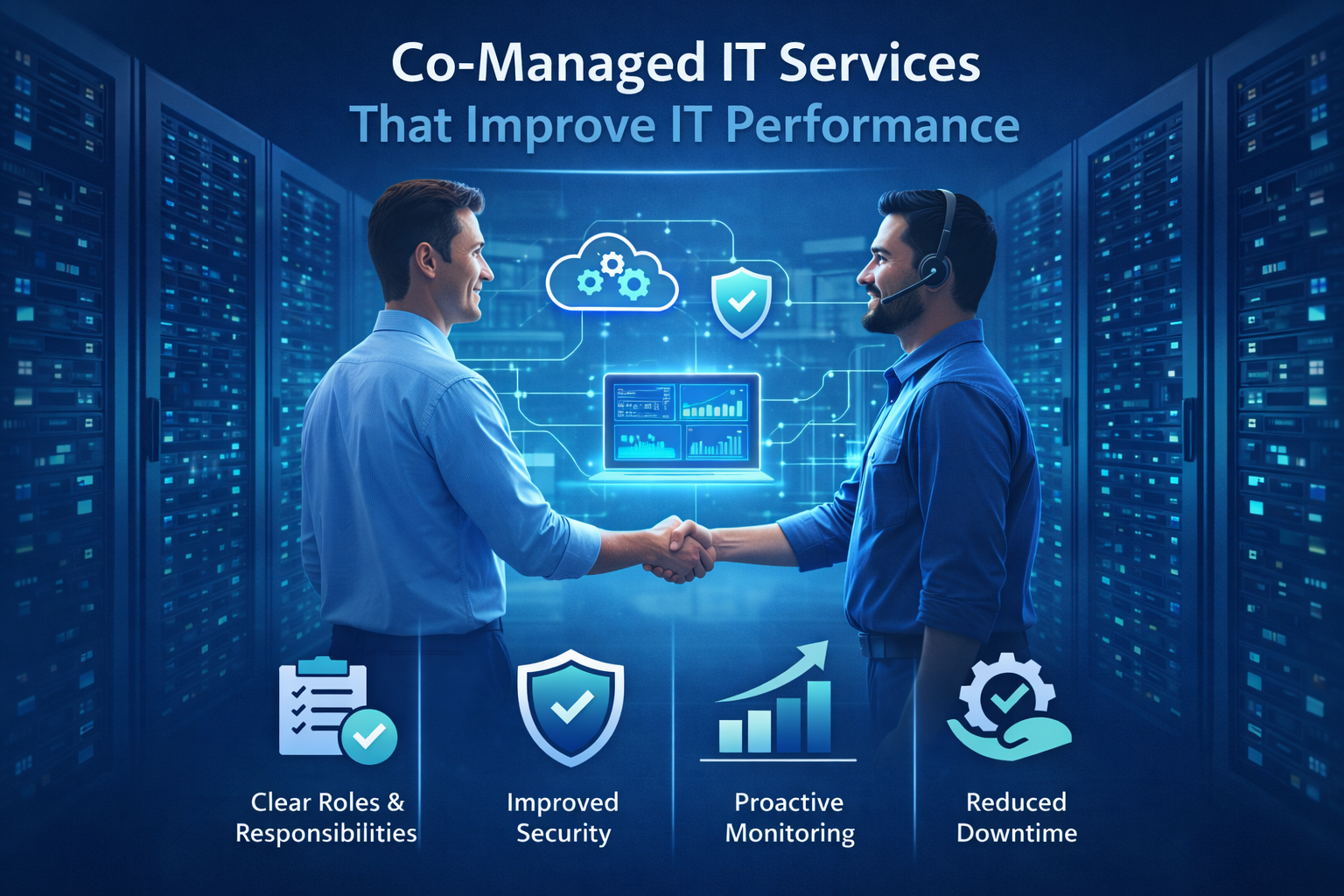
Co-managed IT services give organizations a practical way to strengthen internal IT without replacing it. The model blends your existing team with an external partner that provides additional capacity, structure, and technical depth.
Many organizations reach a point where internal IT is capable but stretched. Priorities compete for attention. Day to day support takes time away from planning and improvement. Co-managed IT services help rebalance that workload and introduce more consistent proactive IT management.
What Co-Managed IT Services Actually Do
Co-managed IT services are not about outsourcing control. They are about adding support where it is needed most.
Your internal team stays close to the business. They understand users, workflows, and priorities. The managed services partner focuses on operational consistency, system monitoring, and technical execution.
This combination creates better coverage across the environment. It also reduces gaps that often appear when IT teams are managing everything alone.
Why Organizations Adopt Co-Managed IT Services
Most organizations do not adopt co-managed IT services because something is failing. They adopt it because growth creates complexity.
Internal teams often spend more time reacting than improving systems. Support requests increase. Infrastructure expands. Security demands become more frequent and more complex.
Co-managed IT services help restore balance by improving consistency and reducing operational strain.
Stronger internal IT performance
Internal teams gain breathing room to focus on strategic work instead of constant interruptions.
More consistent proactive IT management
Monitoring and maintenance become continuous rather than reactive.
Improved security posture
Security tasks are handled with regularity and structure, reducing exposure to risk. You can learn more by visiting NIST’s industry guidance on cybersecurity and resilience standards.
Easier scalability
IT support expands with the business without requiring major restructuring.
Long term operational value
The environment becomes more stable and predictable over time.
You can visit the US Chamber of Commerce to learn more about how organizations are modernizing IT operations.
Defining Responsibilities Clearly
Clarity is one of the most important parts of co-managed IT services. Without it, teams duplicate work or leave gaps.
Responsibility should be clearly defined across core areas.
Internal IT typically owns user relationships, business application knowledge, and alignment with leadership priorities.
The managed services partner typically owns monitoring, patching, infrastructure maintenance, and security operations.
Both sides often share responsibility for escalation handling, vendor coordination, and IT planning.
When responsibilities are documented early, teams move faster and with more confidence. Decisions take less time because ownership is already understood.
Finding the Right Operational Balance
Balance determines whether co-managed IT services succeed or create friction.
Internal IT should remain focused on business context and user experience. That proximity to the organization is valuable and should not be lost.
The managed services partner provides structure, consistency, and technical coverage across the environment.
When both sides operate with clear alignment, IT becomes more predictable. Issues are resolved faster. Planning becomes easier. Execution becomes more consistent.
Balance is not static. It should evolve as systems grow and business needs change.
Planning for Overlap Before It Happens
Some situations naturally involve both teams. Cloud issues, security alerts, and system outages often cross boundaries.
Without planning, these moments can slow response time.
Strong co-managed IT services define these scenarios in advance. Teams agree on who leads during incidents. Escalation paths are documented. Communication expectations are clear.
This preparation removes uncertainty during critical events. It also improves resolution speed when pressure is highest.
Why Structure Is the Foundation
Structure is what turns co-managed IT services into a reliable operating model.
Shared systems, defined workflows, and consistent reporting create visibility across both teams. Everyone understands what is happening and who is responsible.
Structure also supports proactive IT management. Problems are identified earlier. Decisions are based on clearer data. Work becomes more intentional instead of reactive.
For organizations that want to understand how IT supports critical operations and resilience, CISA provides helpful context on infrastructure importance here https://www.cisa.gov/topics/critical-infrastructure-security-and-resilience/critical-infrastructure-sectors/information-technology-sector
Building a Model That Holds Up
A strong co-managed IT model does not rely on constant adjustment. It relies on consistency.
When roles are clear and structure is in place, teams spend less time clarifying ownership and more time improving systems.
Internal IT can focus on initiatives that support the business. The managed services partner maintains stability and performance across the environment.
Over time, this reduces friction and improves overall IT reliability.
What This Means for Your Business
When co-managed IT services are implemented correctly, the impact is measurable.
Downtime decreases because issues are identified and resolved earlier.
Productivity improves because employees experience fewer interruptions.
Costs become more predictable because reactive firefighting is reduced and planning becomes more intentional.
With Artemis IT, the focus is on turning that structure into consistent results. The goal is not just to support your IT environment. The goal is to improve it.
Proactive monitoring reduces unnecessary disruptions. Faster response times keep teams productive. Clear ownership removes confusion during critical moments.
The result is an IT environment that runs with more stability, more predictability, and less operational noise.